How to load a barbell: plate math made easy
Barbell plate math without the mid-set mental arithmetic: what the bar weighs, what "two plates" means, and how the JustGains plate calculator loads for you.
Every lifter has stood at a loaded bar doing arithmetic on their fingers between sets. Plate math is simple in a calm room and surprisingly hard at rep-induced heart rates, and loading the wrong weight quietly ruins a training log. Here is the math once and for all, plus the shortcut built into JustGains.
The formula
A barbell is loaded symmetrically, so the total is: bar weight + 2 × the plates on one side. You only ever need to figure out one side. A standard Olympic bar weighs 45 lb (20 kg); many gyms also have lighter 33 lb (15 kg) and 15 lb (technique) bars, so it is worth knowing which one you grabbed.
Gym slang counts only the biggest plates: "one plate" means one 45 lb plate per side (135 lb total), "two plates" means two per side (225 lb), and so on.
| Total (45 lb bar) | Per side | Gym slang |
|---|---|---|
| 95 lb | 25 | — |
| 135 lb | 45 | One plate |
| 185 lb | 45 + 25 | — |
| 225 lb | 45 + 45 | Two plates |
| 275 lb | 45 + 45 + 25 | — |
| 315 lb | 45 + 45 + 45 | Three plates |
The kilogram version works the same with a 20 kg bar: 60 kg is a 20 per side, 100 kg is two 20s per side, 140 kg is three. Load the heaviest plates first, closest to the bar, and make small jumps with the little plates — steady small jumps are exactly how progressive overload is supposed to feel.
Let the app do the math
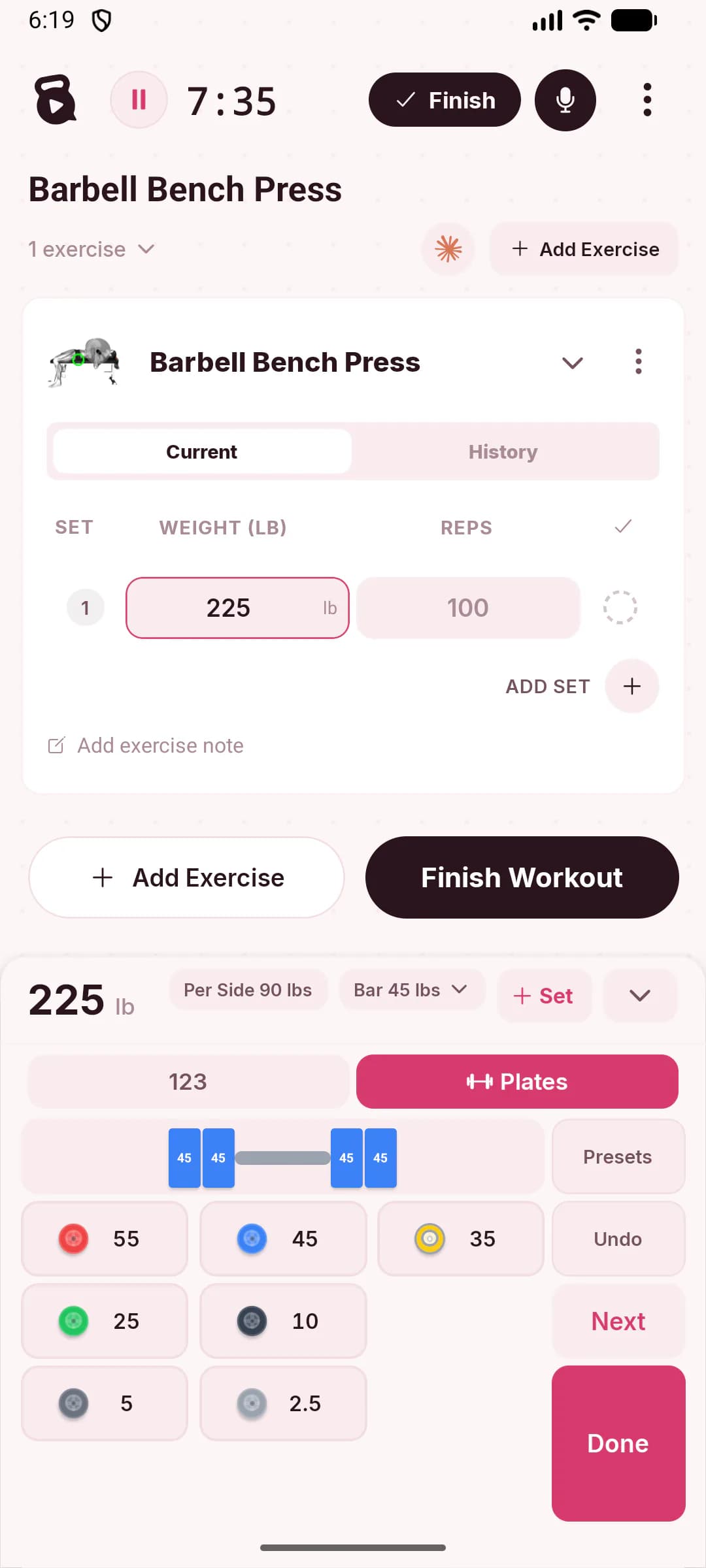
When you log a plate-loaded exercise in JustGains, the weight keypad grows a Plates tab. Type your target weight and the bar diagram shows the exact per-side loadout; or build the weight by tapping plates and watch the total update. The per side readout is what you physically pick up, the bar weight is adjustable for whichever bar you are using, and presets and undo make warmup-to-top-set changes quick.
Single-stack machines: no doubling
Landmines, T-bar rows, leg presses, hack squats, and plate-loaded calf machines have one loading point, not two sleeves. For these the math is just the machine plus the sum of every plate you slide on — nothing is doubled. JustGains knows which equipment works this way and switches the calculator to a single-stack view automatically, so the number you log matches the plates you loaded.
Accurate loading is not just tidiness. Your logged weights feed your estimated 1RM and training volume, and a set logged at 235 that was actually 225 pollutes every number downstream. Load right, log right, and the trends take care of themselves.
FAQ
Keep learning
What is progressive overload?
Progressive overload means giving your body a little more challenge over time.
What is an estimated 1RM?
An estimated 1RM predicts your max from a completed set without requiring a true max attempt.
Sets, reps, and training volume
Training volume is the amount of work you do, usually tracked through hard sets.